

Do Ants Sleep? The Truth About Their 250 Daily Naps
If you have ever watched an ant colony and wondered, do ants sleep, you are not alone. The answer is yes, but not in the way humans do. Ants do not curl up for eight uninterrupted hours. Instead, they survive and thrive on a system of polyphasic sleep, a pattern of many short naps distributed across a full 24-hour cycle. This article unpacks exactly how that works, why queens sleep differently than workers, how an entire colony coordinates rest without a central alarm clock, and what science still has left to learn about insect sleep.
Table of Contents
- What Does “Sleep” Mean for an Ant?
- How Often Do Ants Sleep? The 250-Nap Statistic
- Do Ants Sleep at Night? (No, They Don’t Follow a Day-Night Cycle)
- How Do Ants Coordinate Their Naps as a Colony?
- Do Ants Sleep Standing Up? (And Other Common Questions)
- How Ant Sleep Compares to Human Sleep
- What Science Still Doesn’t Know About Ant Sleep
- Key Takeaways: What We Know About Ant Sleep
- Frequently Asked Questions About Ant Sleep
What Does “Sleep” Mean for an Ant?
Defining sleep in an ant requires stepping back from human expectations. Biologists generally identify sleep by a combination of reduced responsiveness to outside stimuli, lowered brain activity, and a specific resting posture. Ants check all three boxes, even though they lack eyelids and do not experience the rapid eye movement cycles familiar to mammals.
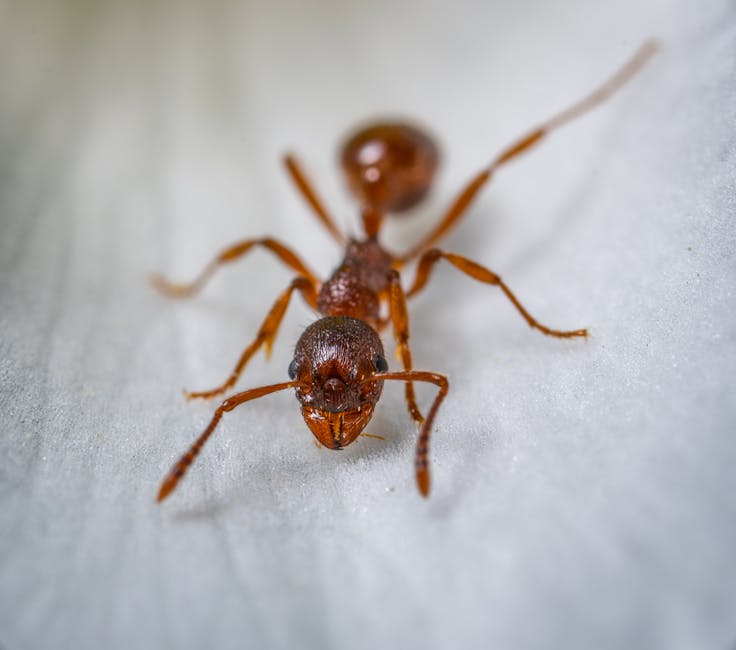
A 1986 study by Basing and McCluskey used brain activity recorders on black and red ants and found a steep decline in brain wave fluctuations during deep rest. That measurable drop in neurological activity is one of the strongest pieces of evidence that what ants do qualifies as genuine sleep, not just passive inactivity. During these deep rest phases, mandible and antennae activity drops by up to 65 percent, according to reporting by The Guardian on the same body of research. An ant that is fully alert constantly samples the air with its antennae and keeps its mandibles ready. A sleeping ant lets both structures go slack.
Ant sleep is polyphasic. There is no single long stretch of unconsciousness. Instead, ants cycle in and out of rest dozens or even hundreds of times within a single day. That rhythm is foreign to most humans, but it is perfectly normal across much of the insect world.
How Often Do Ants Sleep? The 250-Nap Statistic
The most headline-worthy finding in ant sleep research comes from a 2009 University of South Florida study led by Deby Cassill and colleagues. Focusing on fire ants, the research team documented that worker ants take approximately 250 naps per day. Each nap lasts just over one minute on average. Add those up and a worker ant logs about 4 hours and 48 minutes of total sleep in a 24-hour period.
Queen ants follow a noticeably different schedule. The same study found that queens sleep about 90 times per day, with each nap lasting around 6 minutes. That totals over 9 hours of daily sleep, nearly double the worker ant’s rest time. The numbers alone suggest that sleep is not just a biological necessity for ants; it is a resource that gets distributed unevenly based on an individual’s role and status within the colony.

An older 1983 study by James and Cottell had already pointed toward cyclical resting periods in ants, identifying roughly 8 minutes of rest in any 12-hour period. However, that earlier work noted only one of the two daily rest periods resembled true sleep. The Cassill study refined the picture considerably, giving us the specific nap counts and durations that now dominate discussions of ant sleep.
Why Do Queens Sleep More?
The gap between queen and worker sleep makes evolutionary sense when you consider lifespan and metabolic demand. Worker ants live weeks to months. Queens can live for years, sometimes decades in certain species. Longer, deeper sleep appears to support the cellular repair, immune function, and metabolic stability that enable that extended lifespan.
There is also the reproductive angle. A queen’s primary job is egg production, a biologically expensive process that demands significant energy and physiological recovery time. More sleep likely facilitates that output. Workers, by contrast, perform tasks that require shorter bursts of activity interspersed with micro-rests. Their sleep pattern matches their job description.
Do Ants Sleep at Night? (No, They Don’t Follow a Day-Night Cycle)
One of the most common related questions people ask is whether ants sleep at night. The straightforward answer is no, not in the way humans or even many other animals do. Ants lack a traditional circadian rhythm tied to light and dark cycles. Their sleep is dictated by colony demands rather than the position of the sun.
In fire ant colonies, roughly 80 percent of the workforce is awake at any given moment. That statistic, drawn from the same body of research, illustrates the power of staggered napping. The colony never shuts down. Foraging, brood care, nest maintenance, and defense continue around the clock. Individual ants cycle through their naps, but the superorganism remains perpetually operational.
This stands in stark contrast to human sleep architecture. Humans consolidate rest into one primary block, typically at night. Ants distribute rest across the entire day and night. If you check an ant nest at midnight or noon, the scene will look roughly the same: a minority of ants motionless in a resting posture while the majority stays busy.
How Do Ants Coordinate Their Naps as a Colony?
Ant colonies function as superorganisms, where individual behavior serves the collective. Sleep coordination is not centrally planned. No single ant, not even the queen, sends out a signal that says it is nap time. Instead, rest patterns emerge from local interactions and individual responses to colony stimuli, including hunger signals, pheromone concentrations, and physical contact with nestmates.
Worker ants nap in shifts by default. When one worker enters a rest phase, others remain active. Once the resting worker wakes, it resumes its tasks and another worker may settle into a nap. The system is fluid and self-organizing. It ensures that critical functions never go uncovered.
Soldier ants add another layer of complexity. The 1986 Basing and McCluskey study noted that soldier ants showed higher brain activity during deep rest compared to other castes. This suggests soldiers remain partially alert even while sleeping, a kind of sentinel mode that allows them to wake and respond to threats faster than their nestmates. For a caste tasked with colony defense, that neurological difference is a meaningful survival adaptation.
What Happens If an Ant Colony Is Disturbed?
Ant sleep is highly flexible. If a colony is threatened, sleeping ants can wake almost instantly. The drooping antennae snap back to attention, the mandibles close, and the ant rejoins the active workforce within seconds. This adaptability is essential for survival in environments where predators, flooding, or competing colonies can disrupt the nest at any moment. There is no groggy transition period comparable to human sleep inertia. Ants switch from rest to full alertness with minimal delay.
Do Ants Sleep Standing Up? (And Other Common Questions)
Search data reveals that people are curious about the physical details of ant sleep. Do ants sleep standing up? Do they sleep on their backs? The reality is less dramatic than either image suggests.
Ants typically sleep with their antennae drooping downward and their mandibles slightly open. Their body posture relaxes and they may slump closer to the substrate, but they do not lie flat on their backs. An ant on its back is usually a dead or injured ant, not a sleeping one. The sleeping posture is subtle enough that a casual observer might mistake a resting ant for one that is simply paused between tasks.
As for location, ants sleep inside the nest, usually in chambers away from the main traffic areas. These resting chambers provide relative quiet and physical protection. The nest environment buffers against temperature swings and predators, creating safer conditions for the vulnerable rest state.
Do Ants Have Brains?
This related query often surfaces alongside sleep questions, and it is foundational to understanding how ants regulate rest at all. Yes, ants have brains, specifically a structure called the supraesophageal ganglion. An ant brain contains about 250,000 neurons. That is minuscule compared to the human brain’s 86 billion neurons, but it is more than sufficient to control sleep cycles, process sensory input, and coordinate complex social behaviors. The 1986 brain activity study would not have been possible if ants lacked a centralized neural structure to measure.
How Ant Sleep Compares to Human Sleep
Putting ant and human sleep side by side highlights how differently two successful species can approach the same biological need. The comparison also underscores why humans should not romanticize or try to mimic ant sleep patterns.
Sleep duration is the most obvious difference. A healthy adult human typically needs 7 to 9 hours of consolidated sleep per night. A worker ant gets roughly 4.8 hours, but fragmented into 250 separate episodes. The queen gets over 9 hours, closer to the human range, but still broken into 90 naps.
Sleep architecture diverges sharply. Humans cycle through REM and NREM stages in roughly 90-minute loops. Ants have deep rest and lighter rest phases, but there is no evidence of anything resembling REM sleep or dreaming. The brain structures necessary for complex dream generation simply do not exist in an ant’s 250,000-neuron brain.
Circadian regulation is another point of departure. Human sleep is heavily influenced by light exposure and the suprachiasmatic nucleus, which syncs our internal clock to the day-night cycle. Ants operate on a colony-driven schedule that ignores external light cues almost entirely. A human forced onto an ant-like polyphasic schedule would likely suffer cognitive decline, metabolic disruption, and mood disorders. Polyphasic sleep in humans remains controversial and difficult to sustain long-term. Ants evolved for it; humans did not.
Posture also differs. Humans lie down and close their eyes. Ants slump, droop their antennae, and relax their mandibles while remaining upright on their legs. The external signs of sleep are far less obvious in ants, which is part of why the question do ants sleep persists in the first place. People simply do not see ants in an obviously sleep-like state.
What Science Still Doesn’t Know About Ant Sleep
For all the clarity the Cassill study and earlier research provide, significant gaps remain. Most of the data comes from a single species: the fire ant, Solenopsis invicta. Whether carpenter ants, leafcutter ants, or Argentine ants follow similar patterns is largely unstudied. Different ecological niches and colony structures could produce different sleep strategies.
No published research addresses sleep in ant larvae or pupae. Immature ants are developing rapidly and may have entirely different rest requirements, or none at all in the conventional sense. That remains an open question.
Seasonal and climatic influences on ant sleep are also unexplored. Ants in temperate regions that experience cold winters may alter their rest patterns during diapause, a hibernation-like state. Drought conditions, high heat, or tropical versus temperate environments could all shift sleep duration and frequency, but no studies have isolated these variables. Acknowledging these gaps is not a weakness. It shows that ant sleep is an active and incomplete area of entomological research, with plenty of discovery still ahead.
Key Takeaways: What We Know About Ant Sleep
For readers who want the condensed version, here is what the science confirms as of 2026.
Ants do sleep, but in short, frequent naps rather than one long stretch. Worker ants nap roughly 250 times a day, with each nap lasting just over a minute. Queen ants nap about 90 times a day for around 6 minutes per nap, accumulating over 9 hours of total rest. Ants do not follow a day-night cycle; colony needs dictate sleep timing, and roughly 80 percent of the workforce stays awake at any given moment. The sleep posture involves drooping antennae and relaxed mandibles, not lying flat on the back. Most research focuses on fire ants, and other species may differ in ways science has not yet documented.
So, do ants sleep? Absolutely, just not the way we do.
Frequently Asked Questions About Ant Sleep
Do ants sleep at the same time? No. Naps are staggered across the colony so that critical work continues uninterrupted.
How long do ants live? Worker ants typically live weeks to months. Queens can live years, a difference linked in part to their longer, deeper sleep patterns.
Can ants dream? Almost certainly not. Ants lack the brain structures required for the complex neural activity associated with dreaming.
Do ants sleep in winter? Some ant species enter diapause, a hibernation-like state, during cold months. This is physiologically distinct from the daily nap cycles described here and involves a broader metabolic slowdown.
Why do ants never seem tired? Because they nap constantly. An ant is never far from its next rest period, so fatigue never visibly accumulates the way it does in sleep-deprived humans.